

Aluminum Panels for Outdoor: What You Really Need to Know Before You Choose

How Architects and Designers Can Specify Slatted Wall Panels for Interior Design

When you say wood grain to a manufacturer, it can mean several different things. A photographic print. A sublimated film transfer. A powder coat with texture. The performance characteristics differ significantly, as does how the finish ages outdoors. Before you specify wood grain aluminum panels for exterior on a project, understand what you’re actually buying. The finish method affects UV resistance, durability, color consistency, and how the material reads at different distances. Getting this right before the sample arrives matters.
What are Wood Grain Aluminum panels?
Wood grain aluminum panels are created through a powder coating process. The base is extruded aluminum. A powder coat is applied electrostatically. The finish delivers the grain pattern and color variation. This is fundamentally different from a photographic print or vinyl wrap applied to aluminum. The powder coat adheres to the aluminum as a bonded layer, not a surface application. It’s engineered to resist UV fading and atmospheric corrosion across years of exposure.
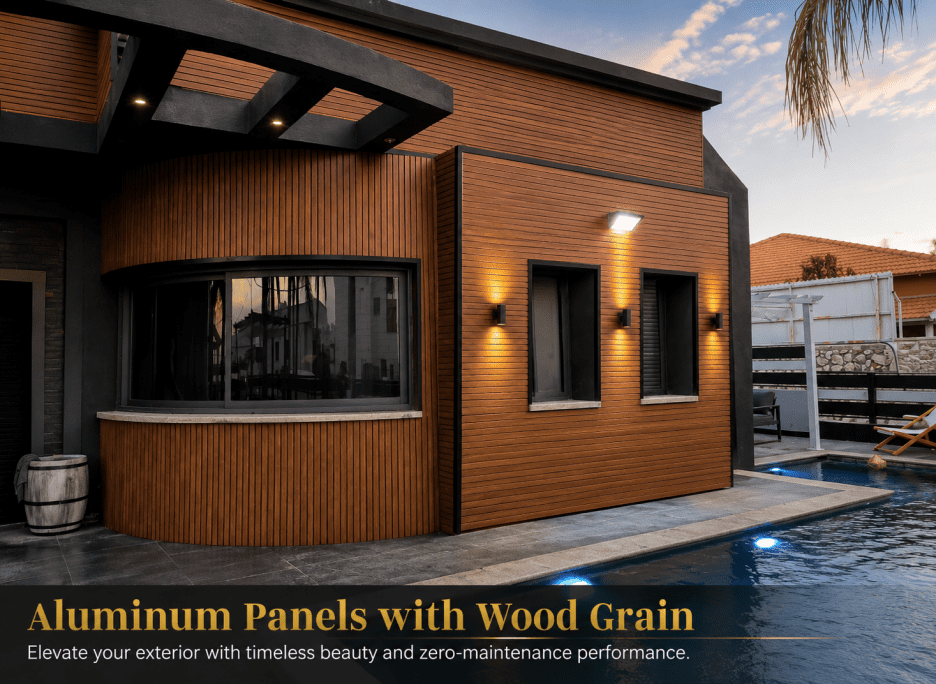
The available tones in wood grain finishes range across light oak, medium walnut, dark espresso, and other tones that approximate natural wood appearance. GTO offers these in their aluminum panel systems. The finish is available across both Click and Universal profile options. This means you’re not limited to a single profile width or system when you choose wood grain. You get the finish option on the profiles that fit your design requirements.
How the Finish Performs Outdoors
Powder coat finishes on aluminum resist UV radiation. This means the color doesn’t fade dramatically across the first year of exposure like some surface treatments do. The coating also resists salt spray in coastal environments and industrial air pollution. For projects in challenging environments, the finish stability is an advantage over materials that degrade more quickly.
Thermal movement occurs. Aluminum expands and contracts with temperature. The powder coat moves with the aluminum. It doesn’t crack or peel from thermal cycling because it’s bonded to the substrate. This is a genuine advantage over vinyl wraps or printed finishes that can separate from the material beneath.
The surface texture on powder coated wood grain finishes is tangible. You can feel it. This tactile quality contributes to how the finish reads at arm’s reach. It’s not a flat print. It has dimensionality. That matters because wood grain finishes are meant to approximate the visual warmth of actual wood, and texture is part of what makes that work.
Where This Finish Looks Convincing
At street distance or courtyard scale, a powder coated wood grain aluminum panels installation reads convincingly as wood. The color variation and grain pattern are intentional. The finish was designed for this range of viewing distance. Someone walking past the building perceives a warm, natural material.
At arm’s reach, the perception changes. The material is obviously aluminum. It doesn’t feel like wood. The weight is different. The temperature is different. The surface, while textured, reads as a manufactured finish, not a natural grain. This isn’t a flaw in the finish. It’s honesty about the material. The finish is solving a real design problem: delivering visual warmth without maintenance burden. It’s not pretending to be something it isn’t.
The grain pattern varies across different light angles and times of day. Morning light reads differently than afternoon light on a textured surface. This variation is intentional. It’s what gives the finish depth and prevents the monotonous appearance of a solid color across a large facade. The variation is subtle but visible.
Specifying Wood-Grain panels on Large Projects
Color consistency across production runs becomes important on larger projects. When you’re ordering material for a 2000-square-foot facade, you want reasonable assurance that panels ordered in month two match panels ordered in month four. GTO’s color guide shows the available range. Sample boxes let you see the actual finish before committing. This is the appropriate process for any project where color matching across multiple orders matters.
The profile width selection affects how the grain pattern reads at facade scale. A wider profile shows more grain variation per panel. A narrower profile shows less. If you’re designing a facade where the linear geometry is important, the profile width choice interacts with the wood grain aesthetic. A 120mm profile with wood grain creates bold horizontal bands. A 40mm profile creates a denser rhythm. Both work. The choice depends on the design intent.
Available finishes include wood grain and solid RAL colors. You can mix them on the same wall. A lower section in a darker wood grain tone. An upper section in a solid matte color. The same system and installation approach handles both finishes. This flexibility allows you to solve design problems without requiring custom fabrication or compromising the installation system.
Thermal Movement and Installation Details
Wood grain aluminum panels installed with a proper system account for thermal movement. GTO’s concealed fixing systems accommodate dimensional movement through the rail-based installation. Individual panels can move slightly without creating visible joint distortion. The joints are designed to accommodate expansion and contraction. This is a system-level advantage that panel-only products often miss.
The U10 Profile seals edges. Angle accessories handle corners. These details work equally well on wood grain and solid color finishes. They’re part of the system, not afterthoughts. This detail attention is what separates a resolved facade from one that looks incomplete at its terminations.
Cost Considerations and Lifecycle
Initial material cost may be slightly higher than solid color finishes. The powder coat process requires the sublimation technology to transfer the grain pattern. This adds manufacturing steps. But across the lifecycle of the facade, there is no maintenance difference. The wood grain finish doesn’t require repainting or resealing. The maintenance obligation is the same as any aluminum exterior cladding: occasional cleaning, no more.
Compared to actual wood cladding that requires repainting every five to seven years, wood grain aluminum is significantly lower cost to own over twenty years. The decision between wood grain aluminum panels for exterior and genuine wood isn’t just about initial cost. It’s about the total cost of ownership and maintenance tolerance.
When to Specify This Finish
Specify wood grain aluminum when you want visual warmth and natural material expression without the maintenance obligations of actual wood. Specify it on projects where the viewing distance is primarily at street scale or courtyard scale, where the finish reads convincingly. Be honest with yourself and the client about what happens at arm’s reach. Specify it on projects where the facade needs to be resolved and maintained for decades without repainting. Specify it when fire code or climate makes actual wood impractical.
Don’t specify it if the design intent fundamentally depends on material authenticity and genuine wood is feasible. In that case, actual wood is the right choice, and you should make that recommendation. But for most residential and commercial projects, wood grain aluminum finishes solve the real problem: clients want the warmth of wood without the maintenance.
Getting Started
Request a sample box. See the finishes in person. Understand how they read at different light angles. Touch them. Feel the texture. Then make the specification with full information. GTO’s color guide documents the available options. The material calculator estimates quantities. Installation documentation is available. You have everything needed to specify this finish clearly and hand off a clear specification to the contractor.
Frequently Asked Questions
Will my client be disappointed when they realize it’s aluminum up close?
Only if you haven’t set expectations. Show them the sample. Explain that the finish delivers wood warmth and texture from a distance without the maintenance. Most clients, once they understand the trade-off, accept it. They’re not trying to fool anyone. They’re solving a practical problem. Be direct about what the material is and what it delivers.
How does wood grain aluminum hold up in high-sun climates?
Powder coat finishes resist UV fading. In high-sun climates, the color will be slightly more stable than untreated wood, which bleaches and grays from UV exposure. Over time, all exterior materials change. Powder coat changes more slowly and more predictably than most alternatives. The finish remains serviceable and visually acceptable for decades.
If I want to order more panels in two years, will they match?
Possibly, possibly not. Color consistency across production runs depends on the manufacturer’s quality control. This is why GTO’s sample box process is important. Keep a sample from your first shipment for reference if future orders are needed. For projects where future expansion is planned, account for this by clarifying expectations with the client before the initial specification.


